
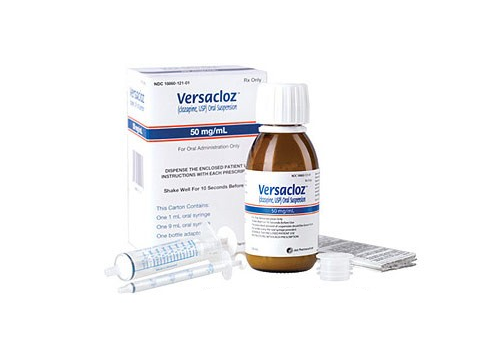




These highlights do not include all the information needed to use VERSACLOZ® safely and effectively. See full prescribing information for VERSACLOZ®.
For your patients with treatment-resistant schizophrenia
These highlights do not include all the information needed to use VERSACLOZ® safely and effectively. See full prescribing information for VERSACLOZ®.
Treatment of severely ill patients with schizophrenia who fail to respond adequately to standard antipsychotic treatment. Because of the risks of severe neutropenia and of seizure associated with its use, VERSACLOZ® should be used only in patients who have failed to respond adequately to standard antipsychotic treatment (1.1).
Reducing the risk of recurrent suicidal behavior in patients with schizophrenia or schizoaffective disorder who are judged to be at chronic risk for re-experiencing suicidal behavior (1.2).
WARNING: SEVERE NEUTROPENIA; ORTHOSTATIC HYPOTENSION, BRADYCARDIA, AND SYNCOPE; SEIZURE; MYOCARDITIS, PERICARDITIS, AND CARDIOMYOPATHY; INCREASED MORTALITY IN ELDERLY PATIENTS WITH DEMENTIA-RELATED PSYCHOSIS See full prescribing information for complete boxed warning. Severe Neutropenia: VERSACLOZ® has caused severe neutropenia, which is associated with an increased risk of serious and fatal infections. Prior to initiating VERSACLOZ® treatment, obtain baseline ANC(s). VERSACLOZ® initiation is not recommended in patients with a baseline ANC less than 1500/µL (less than 1000/µL for those with Benign Ethnic Neutropenia (also known as Duffy-null associated with neutrophil count)). See recommendations for dosage modifications based on ANC levels during VERSACLOZ® treatment (2.4, 2.5, 5.1). Seizure: Risk is dose-related. Titrate gradually and use divided doses. Use with caution in patients with history of seizure or risk factors for seizure (2.2, 5.4). Myocarditis, Pericarditis, Cardiomyopathy and Mitral Valve Incompetence: Can be fatal. Discontinue and obtain cardiac evaluation if findings suggest these cardiac reactions (5.5). Increased Mortality in Elderly Patients with Dementia-Related Psychosis: VERSACLOZ® is not approved for this condition (5.6). |
Known hypersensitivity to clozapine or any other component of VERSACLOZ® (4).
Concomitant use of Strong CYP1A2 Inhibitors: Reduce VERSACLOZ® dose to one third when coadministered with strong CYP1A2 inhibitors (e.g., fluvoxamine, ciprofloxacin, enoxacin) (2.8, 7.1).
Concomitant use of Strong CYP3A4 Inducers is not recommended (2.8, 7.1).
Discontinuation of CYP1A2 or CYP3A4 Inducers: Consider reducing VERSACLOZ® dose when CYP1A2 (e.g., tobacco smoke) or CYP3A4 inducers (e.g., carbamazepine) are discontinued (2.8, 7.1).
Anticholinergic drugs: Concomitant use may increase the risk for anticholinergic toxicity (5.7, 5.15, 7.1).
The most common adverse reactions (≥5%) were:
CNS reactions (sedation, dizziness/vertigo, headache, and tremor)
Cardiovascular reactions (tachycardia, hypotension, and syncope)
Autonomic nervous system reactions (hypersalivation, sweating, dry mouth, and visual disturbances)
Gastrointestinal reactions (constipation and nausea); and
Fever (6.1).
To report SUSPECTED ADVERSE REACTIONS, contact TruPharma, LLC, at 1-877-541-5504 or FDA at 1-800-FDA-1088 or www.fda.gov/medwatch.
Recommended starting oral dosage is 12.5 mg once daily or twice daily (2.2).
If well-tolerated, increase the total daily dosage in increments of 25 mg to 50 mg per day to achieve a target dosage of 150 mg to 225 mg twice per day by the end of two weeks (2.2).
Subsequently may increase the dosage in increments up to 100 mg once or twice weekly (2.2).
Maximum daily dosage is 450 mg twice daily (2.2).
Administer with or without food. See important administration instructions in the full prescribing information (2.3).
See the dosage modifications based on ANC results and recommended frequency of ANC testing in the full prescribing information (2.4, 2.5).
See recommendations for discontinuing VERSACLOZ® treatment (2.6), restarting VERSACLOZ® after interrupting dosing (2.7), dosage modifications for drug interactions (2.8), dosage recommendations in patients with renal or hepatic impairment and CYP2D6 poor metabolizers (2.9) in the full prescribing information.
Severe neutropenia: See Boxed Warning (5.1).
Gastrointestinal Hypomotility with Severe Complications: Severe gastrointestinal adverse reactions have occurred with the use of VERSACLOZ®. If constipation is identified, close monitoring and prompt treatment is advised (5.7).
Eosinophilia: Assess for organ involvement (e.g., myocarditis, pancreatitis, hepatitis, colitis, nephritis). Discontinue if these occur (5.8).
QT Interval Prolongation: Can be fatal. Consider additional risk factors for prolonged QT interval (disorders and drugs) (5.9).
Metabolic Changes: Atypical antipsychotic drugs have been associated with metabolic changes that may increase cardiovascular/ cerebrovascular risk. These metabolic changes include:
Hyperglycemia and Diabetes Mellitus: Monitor for symptoms of hyperglycemia including polydipsia, polyuria, polyphagia, and weakness. Monitor glucose regularly in patients with diabetes or at risk for diabetes (5.10).
Dyslipidemia: Undesirable alterations in lipids have occurred in patients treated with atypical antipsychotics (5.10).
Weight Gain: Significant weight gain has occurred. Monitor weight gain (5.10).
Neuroleptic Malignant Syndrome (NMS): Immediately discontinue and monitor closely. Assess for co-morbid conditions (5.11).
Hepatotoxicity: Can be fatal. Monitor for hepatotoxicity. Discontinue treatment if hepatitis or transaminase elevations combined with other symptoms occur (5.12).
Fever: Evaluate for infection, and for neutropenia, NMS (5.13).
Pulmonary Embolism (PE): Consider PE if respiratory distress, chest pain, or deep vein thrombosis occurs (5.14).
Anticholinergic Toxicity: When possible, avoid use with other anticholinergic drugs and use with caution in patients with a current diagnosis or prior history of constipation, urinary retention, clinically significant prostatic hypertrophy, or other conditions in which anticholinergic effects can lead to significant adverse reactions (5.15, 7.1).
Interference with Cognitive and Motor Performance: Advise caution when operating machinery, including automobiles (5.16).
Pregnancy: May cause extrapyramidal and/or withdrawal symptoms in neonates with third trimester exposure (8.1).
See 17 for PATIENT COUNSELING INFORMATION and Medication Guide.
Pneumonia and other Inflammatory Conditions
Published case reports describe examples where pneumonia or other inflammatory conditions may increase clozapine concentrations. The clinical significance, the impact of treatments to modulate this inflammation, and mechanism of this potential increase in clozapine concentrations have not been fully characterized but may involve reduced cytochrome P450 1A2 activity.